ADHD, Photography, and the Constant Battle Between Creativity and Chaos
I’ve talked before about photography being more than just a career for me. It started as an escape. A coping mechanism. A way to survive a difficult environment when I was younger. But what I haven’t talked enough about is how ADHD has affected nearly every part of my creative life—and honestly, my entire life in general.
Not the trendy social media version of ADHD.
Not the “haha I got distracted” version.
I’m talking about severe ADHD. The kind that can make even the simplest tasks feel mentally overwhelming while simultaneously giving you the ability to hyperfocus on something for 14 hours straight without realizing you forgot to eat.
And photography? It’s both the best and worst thing for that kind of brain.
⸻
The Gift and Curse of ADHD in Photography
ADHD brains are constantly searching for stimulation. We crave novelty, emotion, movement, and challenge. In many ways, photography naturally feeds that need. Every shoot is different. Different people, different lighting, different problems to solve. There’s always something new happening.
I think that’s one reason I became obsessed with photography so young. My brain latched onto it because it was one of the few things that could completely absorb me. When I’m shooting, especially during high-pressure commercial work or creative projects, my brain quiets down. Everything narrows into focus. The light, the composition, the energy in the room—it all just clicks.
But ADHD also creates challenges most people don’t see.
The constant mental noise.
The inability to prioritize tasks properly.
The exhaustion from overthinking every detail.
The struggle to start editing even when you want to.
The feeling of being overwhelmed by emails, admin work, deadlines, file organization, invoicing, scheduling, social media, and every other non-creative part of running a business.
People often see the final image. They don’t see the internal war it sometimes takes to get there.
⸻
Hyper-focus: My Superpower and My Enemy
One of the strangest things about ADHD is hyperfocus. When something grabs my attention creatively, I disappear into it completely. I can spend 12 hours lighting a product shot, building a concept, retouching skin, or perfecting color grading without even noticing time passing.
That level of focus can produce incredible work.
But it comes at a cost.
Because when the hyperfocus ends, it’s usually followed by burnout. Mental exhaustion. Sometimes complete shutdown. It’s like my brain uses a month’s worth of fuel in one sitting.
For years, I thought something was wrong with me because I couldn’t maintain “normal” productivity patterns. I’d have days where I was unstoppable, followed by days where even answering a single email felt impossible.
What I eventually realized is this:
I needed to stop trying to work against my brain and start learning how to work with it.
⸻
Medication Changed My Life
This is something I avoided talking about for a long time because there’s still a weird stigma around ADHD medication. But honestly? Medication helped change my life.
It didn’t suddenly make me “normal.” It didn’t magically solve everything. But it helped slow the mental traffic jam enough for me to function more consistently. Tasks became less overwhelming. I could transition between activities more easily. My emotional regulation improved. My anxiety lowered because my brain wasn’t firing in twenty directions at once.
That said, medication isn’t a miracle solution. It’s a tool.
And like any tool, it works best when combined with systems, habits, self-awareness, and support.
Also—and this is important—not every medication works for every person. Finding the right treatment can take time, patience, and professional guidance. Everyone’s brain chemistry is different.
⸻
The Challenges People Don’t See
One of the hardest parts of severe ADHD is how invisible it can be.
People see talent. They see success. They see creativity.
What they don’t see is the mental exhaustion behind maintaining it.
They don’t see:
* rereading the same email five times because your brain won’t process it,
* sitting in front of Lightroom unable to start editing,
* forgetting appointments,
* losing track of conversations,
* feeling mentally paralyzed by simple tasks,
* struggling with emotional regulation,
* or constantly feeling like you’re underperforming despite trying harder than everyone else around you.
ADHD can create massive guilt. Especially when you’re creative and ambitious. You know what you’re capable of—but getting your brain to cooperate consistently can feel impossible some days.
And burnout hits differently with ADHD. It’s not just “being tired.” Sometimes your brain completely shuts down creatively. You lose motivation, confidence, focus—everything.
⸻
The Systems That Help Me Cope
Over time, I’ve built systems that help me function better creatively and professionally. Not perfectly. Better.
1. Externalize Everything
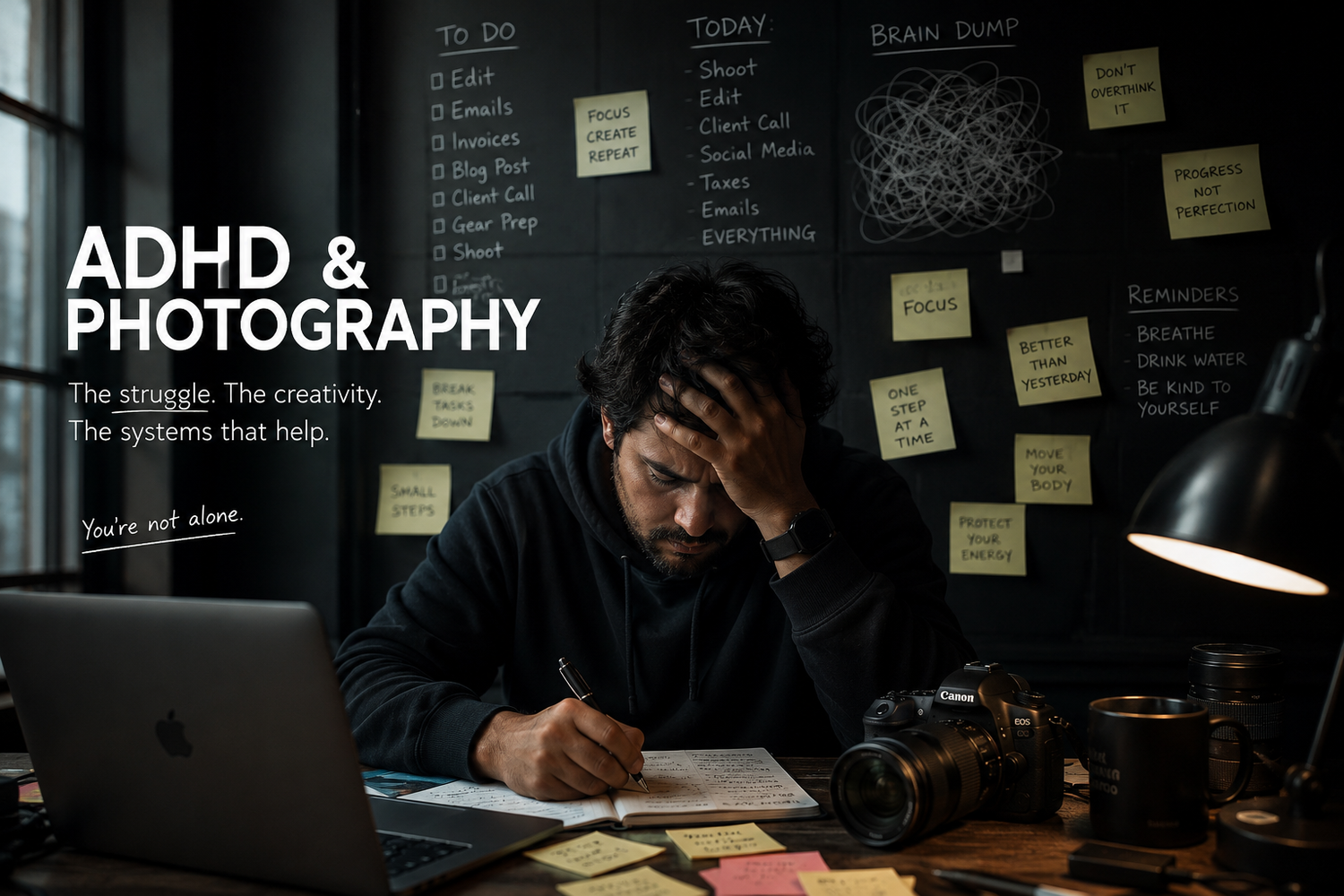
If it stays in my head, it disappears. So I write everything down. Notes apps, calendars, reminders, whiteboards, sticky notes—whatever works. ADHD brains are terrible at holding information internally.
2. Break Tasks Into Ridiculously Small Steps
“Edit photos” feels overwhelming.
“Cull first 20 images” feels manageable.
ADHD brains often freeze when tasks feel too large or undefined. Smaller steps create momentum.
3. Use Timers Constantly
Timers help create urgency without panic. I use them for editing, emails, even breaks. Otherwise I’ll either avoid a task entirely or accidentally spend six hours reorganizing camera bags instead of working.
4. Protect Creative Energy
Not every day is a high-output day. I’ve learned to stop punishing myself for that. Some days are admin days. Some are creative days. Some are survival days. That’s okay.
5. Reduce Decision Fatigue
The more unnecessary decisions I make, the more mentally exhausted I become. So I simplify wherever possible—workflows, gear setups, editing systems, routines.
6. Movement Helps More Than People Realize
When my brain locks up, movement resets it. Walking, stretching, even changing environments can completely shift my mental state. ADHD brains often regulate better through physical movement.
⸻
Why I’m Talking About This
Because a lot of creatives struggle silently.
Especially photographers.
Creative industries often attract neurodivergent people because we naturally think differently, notice details differently, and experience emotion intensely. But many of us spend years feeling broken because our brains don’t operate the way society expects them to.
You’re not lazy.
You’re not failing.
Your brain just works differently.
And honestly? Some of the most creative people I’ve ever met have ADHD.
⸻
Final Thoughts
ADHD has absolutely made parts of my photography career harder. There’s no point pretending otherwise. But it’s also shaped the way I see the world creatively. It’s made me curious, experimental, emotionally connected to my work, and capable of deep creative focus.
I still struggle. Probably always will.
But I’ve stopped viewing ADHD as something I need to “fix.” Now I see it as something I need to understand and manage.
And if you’re reading this while fighting the same battle, just know this:
You’re not alone.
Your creativity still matters.
And your brain isn’t broken. It’s just wired differently.